A distillery's software holds everything worth protecting: recipes, cost prices, supplier terms, customer data, excise records, and the stock ledger for product that is both valuable and portable. Handing every staff member the same login is how small operations start, and it is also how stock losses go unexplained, margins leak to competitors, and audit questions become unanswerable. This guide covers how to structure user access and permissions in distillery management software properly.
Why Access Control Matters More in a Distillery
Spirits are high-value, high-theft-risk inventory, and excise liability means your records are legal documents, not just operational data. If anyone can adjust a stock count or edit a batch record, then nobody is accountable for it, and in a SARS excise audit "someone must have changed it" is not an answer. Access control is not about distrusting staff; it is about making every action attributable, which protects honest staff most of all.
Role-Based Permissions: The Backbone
Rather than configuring rights per person, define roles that mirror how the distillery actually works, and assign people to them:
- Production and cellar staff: create and update batches, record transfers and losses, view recipes they work with, but no visibility of cost prices, margins, or customer data.
- Tasting room and POS staff: process sales and returns under their own user, with voids and discounts above a threshold requiring a manager.
- Sales and CRM users: quotes, orders, and customer records, without access to production or purchasing.
- Finance: invoicing, supplier payments, and reporting, typically read-only on operations.
- Administrators: user management, master data, and settings, held by as few people as possible.
The principle is least privilege: each role gets what the job requires and nothing more. Sensitive data, above all recipe costings and margins, should be visible only to roles that genuinely need it.
Audit Logs: Transparency That Protects
Permissions control what people can do; audit logs record what they did. A proper audit trail captures who created, edited, or deleted a record, when, and what changed. This matters in three situations: investigating a stock discrepancy, answering an excise or financial audit, and resolving internal disputes. When staff know actions are logged under their own login, casual shortcuts and "quick fixes" to stock numbers largely stop on their own.
POPIA and Customer Data
South African producers holding customer data are subject to POPIA. Access control is a core part of compliance: customer contact details and purchase histories should be visible only to roles with a business need, and offboarded staff must lose access immediately. Being able to demonstrate role-based restriction of personal information is exactly the kind of appropriate, reasonable technical measure the Act expects of a business.
Multi-Site Operations: Local Control, Central Oversight
Distilleries running a production site plus tasting rooms or a second warehouse need location-aware permissions: a site manager sees and manages their own operation, while owners and head office see the consolidated picture. Stock transfers between sites should require a sender and a receiver, so quantities cannot silently change in transit.
Practical Onboarding and Offboarding
- Create each user against a role, never a shared "staff" login, and never share the admin account.
- Review who holds admin rights quarterly; the list only ever grows unless someone prunes it.
- When someone leaves, disable the account the same day. Their history stays attributable; their access ends.
- Check that permission changes themselves are logged, so rights cannot be quietly escalated.
Frequently Asked Questions
Should production staff see recipe costs?
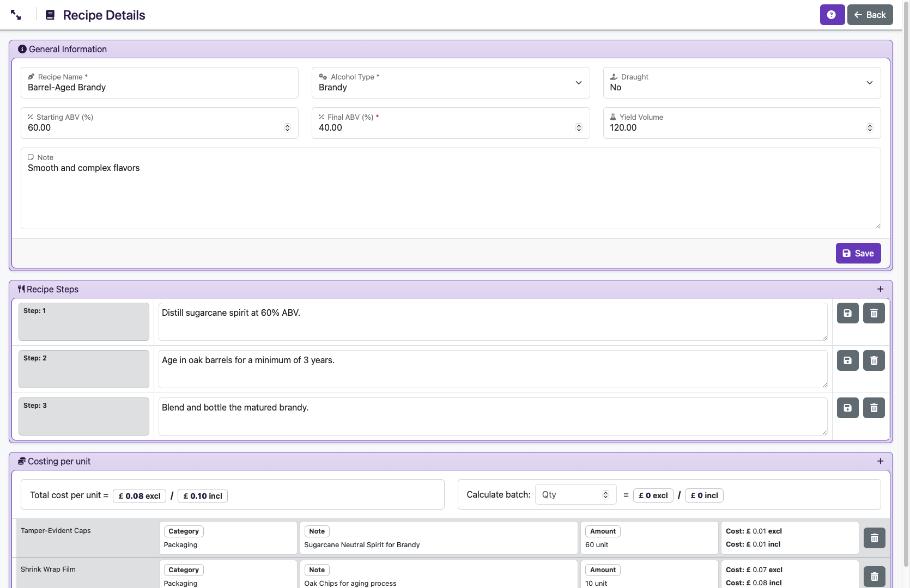
Usually not. Staff need quantities and method to execute a batch; unit costs and margins are commercially sensitive and belong with management and finance roles. Good software separates the recipe's operational view from its costing view.
How many administrators should a small distillery have?
Two is the practical minimum, so a password reset or emergency never depends on one person, and the number should stay in single digits even in larger operations. Everyone else works from scoped roles.
Do audit logs actually deter internal theft?
They deter the opportunistic kind, which is most of it, and they turn the rest from an unsolvable mystery into a short investigation. Combined with per-user POS logins and enforced stock counts, attributability is the single strongest internal control a distillery can add.
Conclusion
User management is cheap insurance for a distillery: least-privilege roles, per-user logins, a real audit trail, and disciplined offboarding. Liquor Logic ships with role-based permissions, per-user activity tracking, and multi-location controls built in, so you can run all of this from one platform without extra tooling. Book a demo to see how it fits your team structure.