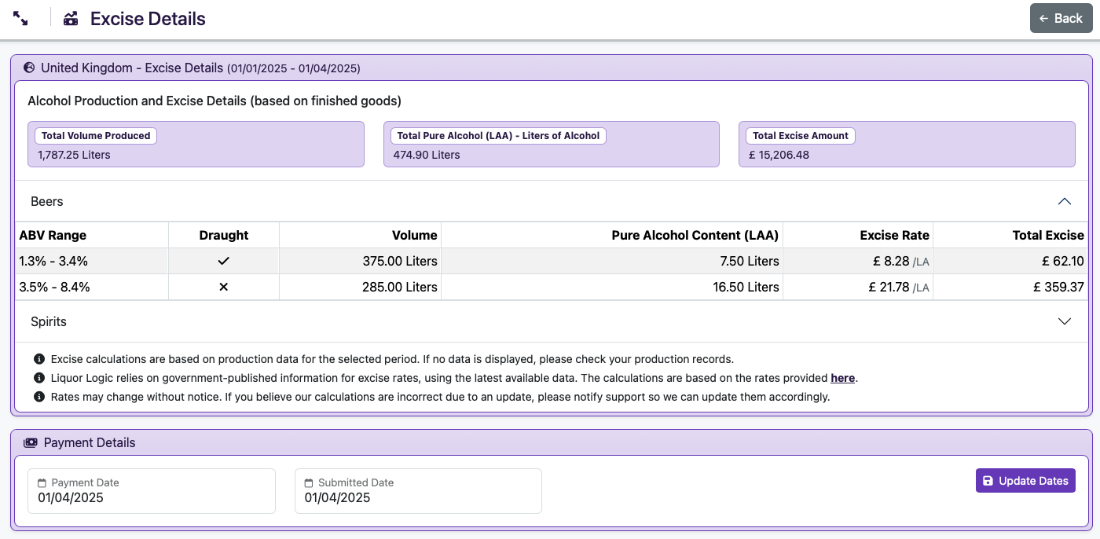
For a South African distillery, excise is not a year-end tax exercise; it is a monthly operational discipline. Every litre of spirit you produce creates a duty liability that SARS expects you to declare accurately, on time, from records that survive an audit. Producers who manage this in spreadsheets spend days each month reconstructing volumes and live with the quiet fear that the numbers will not tie up when an auditor arrives. This guide explains what excise reporting actually requires and how distillery software removes most of the pain.
How Excise Works for a Distillery
Licensed distilleries operate a customs and excise warehouse, and product moving through it is tracked in an excise account submitted to SARS on a recurring cycle (the DA260 family of returns for spirits). Duty on spirits is levied per litre of absolute alcohol (LAA), which means every declaration depends on two measurements: volume and alcoholic strength. Production, transfers between bonded warehouses, duty-paid removals, exports, and losses all have to be declared in the correct category, and the closing balance of your excise account must agree with the physical stock in the warehouse. If the concept is new to you, start with our primer on what excise duty is in South Africa.
Where Manual Excise Reporting Goes Wrong
- LAA arithmetic: converting bulk litres at varying strengths into litres of absolute alcohol, batch after batch, is exactly the kind of repetitive calculation where spreadsheet errors breed.
- Bonded versus duty-paid confusion: once bonded and duty-paid stock share a storeroom without systematic separation, the excise account drifts from physical reality.
- Losses left undocumented: angel's share, filtration losses, breakages and samples are all legitimate, but only if recorded when they happen, in a form SARS accepts.
- Reconstructed submissions: compiling a return at month-end from memory and scattered notes produces plausible numbers, not verifiable ones. Auditors can tell the difference.
The consequences are not theoretical: under-declared duty attracts penalties and interest, and a warehouse licence is conditional on adequate record-keeping.
What Software Changes
Distillery software with excise support turns the excise account from a monthly reconstruction into a by-product of normal work:
- Duty calculated at source: every batch records volume and ABV once, and the system derives LAA and the duty implication automatically, using current rates.
- Bonded stock separated by design: bonded and duty-paid stock live in distinct locations in the system, and a removal from bond is an explicit, logged transaction rather than a note on a whiteboard.
- Losses recorded in the moment: maturation, processing, and handling losses are captured against the batch as they occur, building the audit trail continuously.
- Returns built from transactions: the monthly declaration is generated from the same movement records that run the business, so the excise account and the stock ledger cannot disagree.
- An audit trail by default: who recorded what, when, with quantities and timestamps, available years later. See our guide to alcohol production compliance in South Africa for the wider record-keeping picture.
Beyond South Africa
The same architecture serves producers reporting to other authorities: Australian producers reporting to the ATO and UK producers dealing with HMRC face the same core problem of converting production records into per-litre-of-alcohol declarations. If your distillery exports or operates across borders, one system that keeps jurisdiction-specific records beats parallel spreadsheets in every case.
Frequently Asked Questions
What records does SARS expect a distillery to keep?
Production records per batch (volumes and strengths), receipts into and removals from the bonded warehouse, duty-paid removals, exports, documented losses, and the running excise account that ties them together. Records must be retained and producible on request, typically for five years.
How is excise duty calculated on spirits?
Spirits duty is set per litre of absolute alcohol. Multiply product volume by its alcoholic strength to get LAA, then apply the current rate published in the annual Budget. A 700 ml bottle at 43 percent ABV contains 0.301 LAA; software does this across thousands of bottles and every strength you produce without arithmetic slips.
What happens if excise records are incomplete during an audit?
SARS can assess duty on unexplained shortfalls, add penalties and interest, and in serious cases review the warehouse licence itself. Undocumented losses are treated as unaccounted removals, which is why recording losses as they happen matters so much.
Can software keep up when duty rates change?
Yes. Rates change at least annually with the Budget; a maintained platform applies the correct rate by date, so declarations spanning a rate change remain accurate without manual rework.
Conclusion
Excise compliance rewards systems, not heroics. When duty maths, bonded separation, and loss records are handled at the moment of work, the monthly return becomes a report you generate, not a project you dread. Liquor Logic includes excise management built for South African producers, with production tracking, bonded stock control and audit-ready records in one platform. Book a demo and bring your last DA260 along to compare.