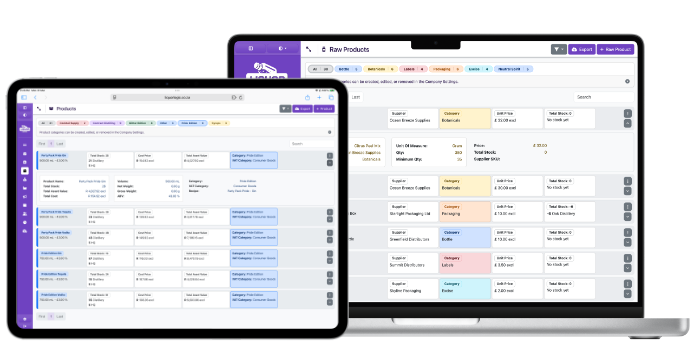
Distillery inventory is deceptively complicated. A brewery turns its stock over in weeks; a distillery may hold product for years, lose a percentage of it to evaporation, and carry thousands of rand of packaging for a release that ships twice a year. Managing that on spreadsheets means discovering problems after they have cost you money. This guide covers what smart distillery inventory management looks like in practice: full visibility, forecasting, and cost control from grain to dispatched case.
Beyond Bottles: What Distillery Inventory Actually Involves
- Raw materials: grain or molasses, botanicals for gin, yeast, and water treatment inputs, several of them perishable or seasonal.
- Work in progress: wash, low wines, new-make spirit, and product resting in tanks between stages.
- Maturing stock: barrels holding value for years, subject to angel's share evaporation and needing per-cask identity, fill date, and strength history.
- Finished goods: bottled product by SKU, batch, and location, bonded or duty-paid.
- Dry goods: bottles, closures, labels, cartons, and capsules, cheap per unit and catastrophic when absent on bottling day.
Each category fails differently: botanicals expire, barrels evaporate, labels arrive with eight-week lead times. A system that treats them all as generic "stock" hides exactly the differences that matter.
Real-Time Tracking That Matches How Distilleries Work
Liquor Logic tracks every category in one live inventory view: recipes drive raw material consumption when a batch is created, transfers between tanks and locations are logged movements, and finished goods flow through to tasting room sales and trade orders without re-entry. Losses, including maturation evaporation, are recorded against the batch so that yield, cost, and the excise account all stay truthful. That last point is not optional: bonded and duty-paid stock must stay separated, and our guide to excise reporting explains what auditors expect to see.
Forecasting Built for Distilleries
Forecasting in a distillery has two horizons. Short term, sales velocity by SKU tells you when finished stock runs out and when the next bottling run must land, which in turn schedules dry goods orders against supplier lead times. Long term, maturation planning is the real game: the whisky you can sell in 2029 is capped by the barrels you fill in 2026. A system holding both your sales history and your cask inventory lets you model release schedules years ahead instead of discovering a gap when it is unfixable.
Practical forecasting discipline looks like this:
- Reorder points per material, set from lead time plus a safety buffer. Imported botanicals and custom glass in South Africa can carry lead times of six to twelve weeks; the reorder point must know that, not you.
- Seasonality factored in: gin sales spike in summer and December trade; buying flat quantities year-round guarantees both stockouts and dead capital.
- Batch planning from demand: production runs sized from forecast consumption, not from tank availability alone.
Dry Goods and Packaging: The Unglamorous Money Pit
Packaging is where distilleries quietly bleed cash: over-ordered custom labels for a discontinued variant, bottle stock counted in "roughly enough" units, closures that run out mid-run. Treat dry goods as first-class inventory with the same reorder logic as botanicals, and reconcile them at every bottling run; variance between theoretical and actual usage is an early warning of breakage, theft, or a supplier short-delivering.
What Cost Control Actually Comes From
The savings from smart inventory are specific and measurable: less spoilage because perishables are used first-expired-first-out, less capital parked in overstock, fewer emergency purchases at premium prices, honest per-batch costing because every input is recorded, and no production days lost to a missing R2 component. Producers watching input costs climb should also read our analysis of craft alcohol cost inflation.
Frequently Asked Questions
How should a distillery track angel's share losses?
Record evaporation per cask against the batch, either from periodic regauging or an agreed percentage validated by measurement. The loss affects yield, unit cost, and the excise account, so it belongs in the system, not in folklore.
What is the best way to set reorder points for a distillery?
For each material: average consumption per week, multiplied by supplier lead time in weeks, plus a safety buffer sized to variability. Review quarterly; lead times and sales mix both drift.
How does inventory software reduce distillery costs?
By making waste visible while it is still preventable: expiry warnings before spoilage, reorder alerts before emergency freight, batch costing that exposes recipe drift, and stock counts that surface shrinkage in weeks rather than at year-end.
Conclusion
A distillery's inventory is its balance sheet in physical form, from sacks of juniper to casks appreciating in the warehouse. Liquor Logic gives you live control of all of it, with forecasting, reorder automation, batch costing, and excise-ready records in one platform built for producers. Book a demo to see your own stock flow through it.