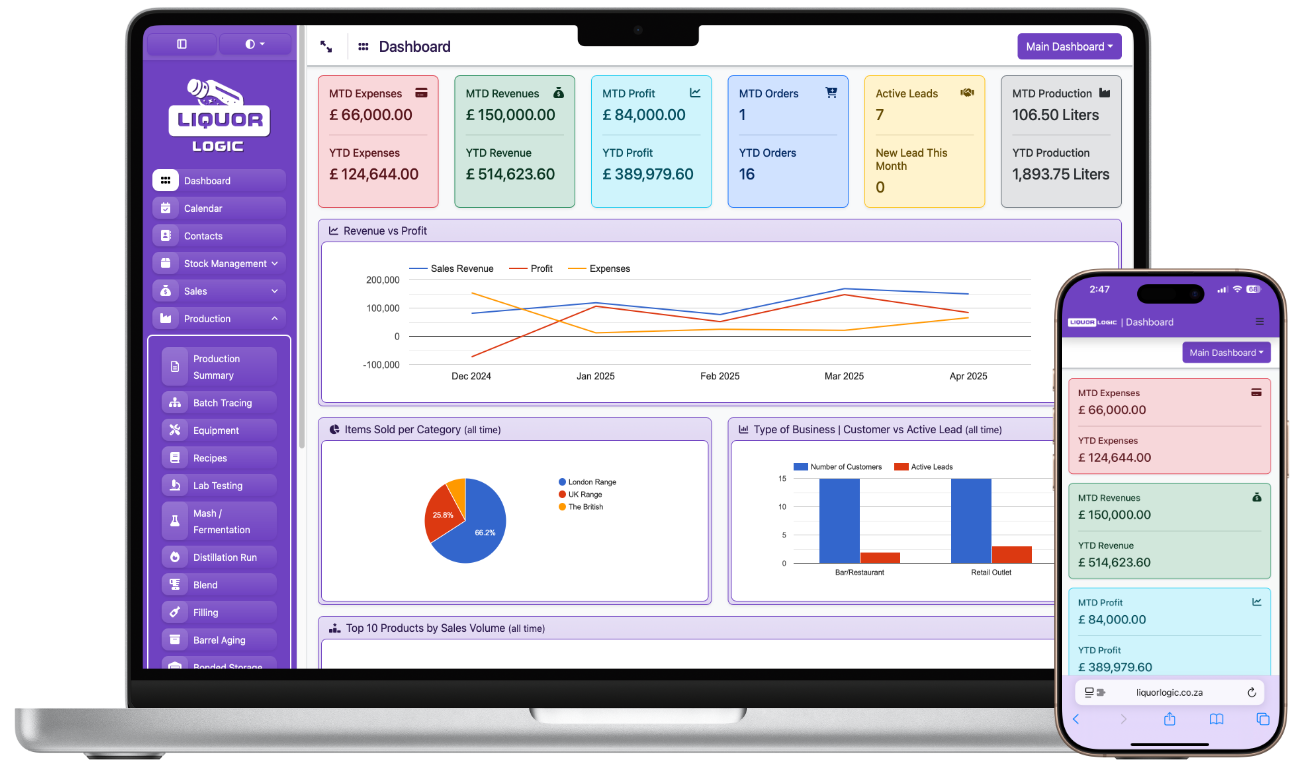
Running an alcohol production business in 2025 is not just brewing, distilling, or winemaking. It is excise accounting, batch traceability, bonded stock control, multi-channel sales, and cost management, all under regulatory scrutiny that generic business tools were never designed for. This article explains, concretely, why producers outgrow spreadsheets and generic ERPs, and what specialized software must actually do.
The Workload Nobody Warned You About
Every producer eventually discovers the same pattern: the craft is the smaller half of the job. A typical week includes reconciling stock across cellar, warehouse, and tasting room; costing batches whose inputs were bought at three different prices; preparing excise figures per litre of absolute alcohol; chasing trade orders taken by phone; and answering "can we make the wedding order by Friday?" without a live stock number to check. None of this is optional, and all of it punishes improvised tooling.
Where Spreadsheets Break
- No live state: a spreadsheet records what someone remembered to type, hours or days after the fact. Stock decisions get made against stale numbers.
- No traceability: linking a finished bottle back to ingredient lots, essential for recalls and audits, is practically impossible across disconnected sheets.
- No accountability: anyone can edit anything, silently. In an excise context that is not just messy, it is a compliance exposure.
- Single-person risk: the person who built the workbook becomes the only person who understands the business's data.
Why Generic ERPs Disappoint Producers
Generic ERPs and accounting add-ons understand buying and selling widgets. They do not understand fermentation losses, maturation over years, angel's share, bonded versus duty-paid warehouses, duty per litre of absolute alcohol, or recipes whose yield varies by batch. Producers who implement them end up rebuilding the industry logic in customisations and side spreadsheets, paying enterprise prices for a system that still cannot produce an excise return. Our software evaluation guide covers how to test for this before you buy.
What Specialized Software Must Cover
- Production and batch management: recipes, batch execution, stage tracking, losses, and yields, with every batch costed from actual inputs.
- Real-time inventory: raw materials, work in progress, maturing stock, finished goods, and dry goods, across locations, with reorder automation.
- Excise and compliance: bonded stock separation, litres-of-absolute-alcohol calculations, and audit-ready records; see our excise reporting guide for what SARS expects.
- Sales channels: a tasting room POS and trade ordering through a portal like Order Hub, both drawing on the same live stock.
- CRM: customer history across retail and trade, feeding clubs, reorders, and direct marketing.
- Reporting: margin by SKU and channel, yield trends, and slow stock, available weekly rather than at year-end.
Signs You Have Already Outgrown Your Tools
You recognise the moment less by size than by symptoms: stocktakes produce surprises, batch costs are estimates, excise preparation takes days, sales are promised against stock that turns out not to exist, and adding a second location or a new product line fills you with administrative dread. Any two of those symptoms mean the tooling, not the team, is the constraint.
Frequently Asked Questions
Is specialized software worth it for a small craft producer?
Yes, and often proportionally more than for large ones, because the same person doing the distilling is doing the admin. Platforms priced for craft producers, see our pricing, cost a fraction of the working time and stock losses they eliminate.
Can one system really replace POS, inventory, production and compliance tools?
That is precisely the point of producer-specific platforms: one stock ledger serving production, tasting room, trade orders, and excise, instead of four systems reconciled by hand. Compare that architecture against point solutions in our comparison pages.
How disruptive is switching from spreadsheets?
With clean master data, small producers typically go live in weeks, not months, and the switch is staged: records first, then production and inventory, then sales channels. Our digital transformation roadmap lays out the sequence.
Conclusion
Alcohol production has specific physics, specific law, and specific economics; software that does not understand them leaves you doing the understanding by hand. Liquor Logic was built for distilleries, breweries, wineries, and cideries from the first line of code, covering production, inventory, excise, POS, and CRM in one platform. Book a demo and bring your hardest spreadsheet with you.